
Hospital Notary Public Signing Checklist
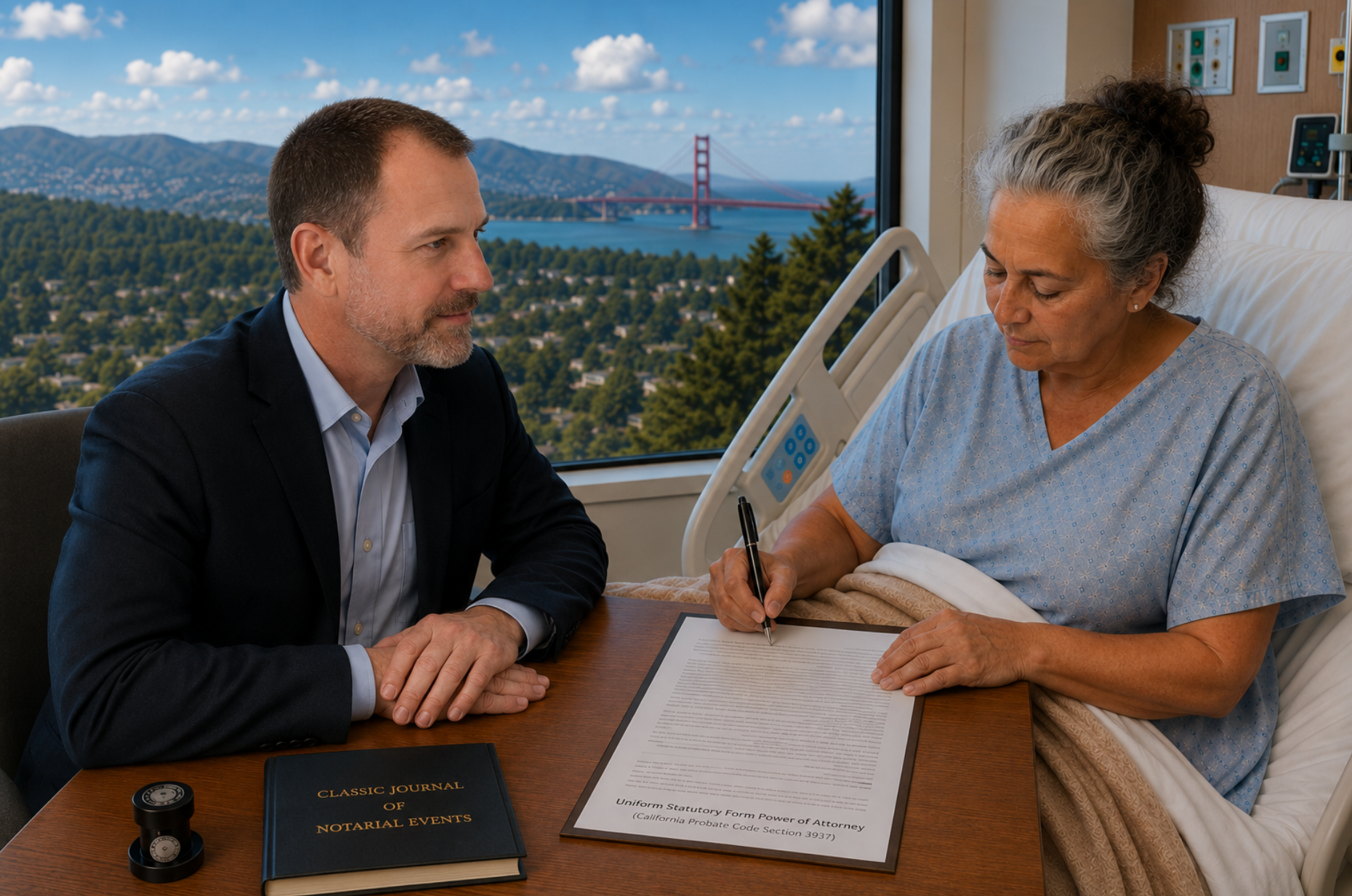
Every notary public on our team has years of experience assisting patients with signing documents in hospital rooms at CPMC, Kaiser Permanente, UCSF, the Jewish Home, and many other hospitals, skilled nursing facilities, and care centers throughout the San Francisco Bay Area.
Need a mobile notary at a hospital, rehab center, nursing home, skilled nursing facility, or hospice care facility in San Francisco or the Bay Area? SF Notary + Apostille explains how the process works.
Our San Francisco hospital notary public team members are regarded for their patience and compassion serving medical patients and the elderly.
The process and requirements for notarizing important documents for a medical facility are no different than if we were meeting outside of the facility. However, there are several factors to consider when planning and organizing a hospital traveling notary public appointment.
Here’s a checklist we created to make the process as smooth as possible:
Step 1: Determine Document Requirements
In California, a notary public cannot provide or recommend documents to clients, as that may be considered an unlicensed practice of law. In conversations with clients, most people tell us they obtained their documents from an attorney or a hospital social worker. Others say they downloaded their documents from a government website or a private website like LawDepot, LegalZoom, or Rocket Lawyer. Whichever way you obtain your document, we recommend consulting legal counsel to ensure you have the right document for your situation.
For reference only, the following are the most common types of documents we see people sign while in the hospital.
Advance Health Care Directive / Health Care Power of Attorney
According to the California Attorney General (AG), an advance health care directive “lets your physician, family and friends know your health care preferences, including the types of special treatment you want or don't want at the end of life, your desire for diagnostic testing, surgical procedures, cardiopulmonary resuscitation and organ donation.”
The AG offers a fillable template, which you can access by clicking on the following text: California Advance Health Care Directive. Please consult with an attorney to determine if this document might be right for your situation.
Durable Power of Attorney
According to the National Cancer Institute, a durable power of attorney (DPA) is a legal document that “gives one person (such as a spouse, relative, friend, or lawyer) the authority to make medical, legal, or financial decisions for another person.”
The signer can choose to make some durable power of attorney documents take effect immediately or at a future point when they can no longer able to make decisions for themselves. Usually the DPA lasts until the signer dies or chooses to revoke it.
The San Mateo County Law Library offers a fillable template you can access by clicking on the following text: Uniform Statutory Form Power of Attorney. Please consult with an attorney to determine if this document might be right for your situation.
If a power of attorney is needed to access a bank or investment account, we recommend discussing requirements with the financial institution, as their processes might require the execution and notarization of a specific version of a power of attorney or additional documents.
Will
According to the CA Attorney General, “One way you can control the distribution of your property after death is through a will.” The Sacramento County Public Law Library offers a template that you can access by clicking on the following text: California will. Please consult with an attorney to determine if this document might be right for your situation.
In California, wills are usually not notarized and instead need to be signed by two impartial witnesses. An impartial witness cannot be a direct or indirect beneficiary of the will. One of our hospital notaries can serve as one witness, and you can provide the other or we can bring a second witness with us for an additional fee.
IMPORTANT NOTE: Many hospitals have policies that forbid nurses and other staff from acting as witnesses. Consult with the facility staff prior to setting your notary appointment.
Step 2: Ensure that the Patient Has an Acceptable Form of ID
At the notary appointment, the patient will need to present satisfactory evidence of their identification. The most common forms of acceptable IDs are listed below. The ID must be unexpired and/or issued within the last 5 years. A photocopy or picture of an ID card is not acceptable.
Passport issued in the USA or any foreign country
Driver’s license issued in the USA, Mexico, or Canada
DMV-issued ID (including Senior ID) card issued in the USA
US military ID
California state, county, or city employee ID
NOTE: A green card is not an acceptable ID
If the patient does not have an acceptable form of identification, the patient or the patient's family will need to arrange for two credible witnesses to be present at the notary appointment. Each credible witness must present an acceptable form of identification, swear or affirm under oath that they personally know the signer, and sign the notary's journal. The credible witnesses must also satisfy all requirements under California notary law.
Important: Many hospitals and healthcare facilities have policies that prohibit nurses, physicians, social workers, and other staff members from serving as credible witnesses. We recommend confirming the facility's policy before scheduling your hospital notary appointment.
Step 3: Determine Patient Eligibility to Sign
To ensure a successful hospital notary appointment, the patient must be fully awake, alert, and able to demonstrate to the notary that they understand the nature and purpose of the document they are signing. The notary will communicate directly with the patient to determine whether the patient appears aware, willing, and capable of understanding the transaction. A notary public cannot notarize a document if the patient is unconscious or appears unable to understand what they are signing due to a medical condition, cognitive impairment, or the effects of medication.
Please notify the nursing staff of the signing appointment so that they can alert you if the patient might be unavailable due to testing or other procedures.
Step 4: Determine Physical Ability to Sign
Jittery signatures due to the effects of a patient’s medical condition or medications can usually be notarized. But if the patient is struggling with the pen, perhaps due to a stroke or weakness, they can sign their name with an X or just a mark.
The signature by mark method requires two disinterested witnesses to sign the document and write their names on both the document and in the notary's journal. One of these witnesses must also write the signer's name next to the signer's mark. The witnesses do not need to know the signer personally, but they must not have any financial or beneficial interest in the transaction or otherwise benefit from the signer executing the document. The notary public cannot serve as one of these witnesses.
Signature by mark witnesses do not present their ID to the hospital notary or sign the notary’s journal.
IMPORTANT NOTE: Many hospitals have policies that forbid nurses and other staff from acting as signature by mark witnesses. Consult with the facility staff prior to setting an appointment.
Step 5: Determine if an Ombudsman Is Needed
If the patient is in a Skilled Nursing Facility (SNF) and needs to sign an Advance Health Care Directive, it may be necessary to have an ombudsman present at the signing. We recommend contacting the facility’s staff, most likely the patient’s social worker, for help securing and scheduling an ombudsman. Once you know the ombudsman’s availability, we will try to make it work with our schedule.
Information on the role of an ombudsman can be found by clicking on the following link: California Department of Aging—Long-Term Care Ombudsman
Signings that occur in a medical facility other than a Skilled Nursing Facility do not require the presence of an ombudsman.
Step 6: Schedule Your Notary Appointment
Once you have reviewed the steps above and determined that the patient is ready to sign, schedule a mobile notary appointment by calling +1 (415) 655-9455 or emailing info@sfnotary.com. Rush, evening, and weekend appointments are often available. We accept cash, check, PayPal, or credit card payments.